
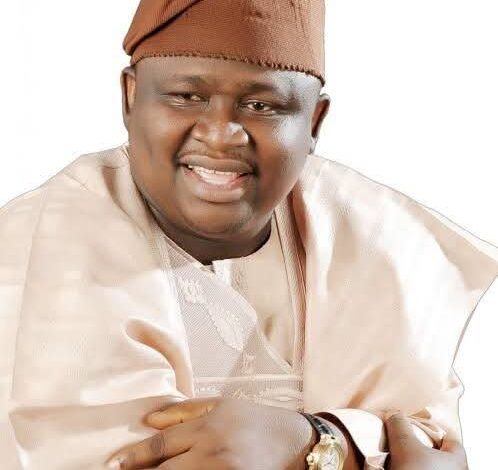
Let it be said that when it was Yewa’s turn to produce the Governor of Ogun State, a stranger emerged to claim the crown. Now, another crown, the traditional throne of their monarch, may soon be worn by someone whose claim to the heritage is already generating questions. Is this the continuation of a troubling pattern in which the aspirations of a people are repeatedly appropriated by others?
An older friend once told me that it was a taboo, perhaps even a curse, for a Yewa person to become Governor of Ogun State unless a stranger was presented as one of their own. Looking at recent political developments, one is tempted to ask whether that supposed curse remains unbroken, or whether some of the very people entrusted with advancing the Yewa cause have become its greatest obstacle.
In the build-up to the 2015 governorship election, Olumide Osunsina, a prominent property developer and owner of Megamound Properties, emerged on the political scene with an ambition to become Governor of Ogun State under the Yewa Agenda banner. Armed with substantial financial resources, he attracted a familiar circle of political figures, some of whom are again associated with the political calculations surrounding Yayi’s governorship aspiration. Among them were Mrs Iyabo Apampa, former Deputy Governor Salimot Badru, Dapo Oke, Kayode Oni and Alhaji Bisiriyu Popoola.
Reports and political accounts from that period suggested that Osunsina’s residence in Apapa, Lagos, became a regular meeting point, while his Megamound hotel in Idi-Ape, Ibadan also became their favourite spot. The campaign was presented as a vehicle for Yewa emancipation, with Osunsina marketed as a governor-in-waiting who would finally deliver political power to the people.
Yet, beyond the rhetoric of identity and representation, an uncomfortable question persists: was the project truly about the collective aspirations of Yewa people, or was it about the political convenience of those who gathered around a wealthy aspirant?
Recent reports identifying Osunsina as the Olu-elect of Ifo have revived that question. Where exactly does Ifo sit within the geography and political identity of Ogun West? And what does this development say about the way ethnic identity, traditional heritage and political ambition are being negotiated in Ogun West?
The concern is not that individuals should be denied their rights to aspire to political office or traditional institutions. Rather, it is that the language of collective emancipation must not become a convenient instrument for advancing private interests. A cause built on identity, history and representation deserves more than a political label that can be deployed whenever it becomes expedient.
Indeed, the impression being created is that the Yewa Agenda has become vulnerable to the highest bidder. In such an arrangement, financial muscle appear to count for more than ancestry, longstanding community ties or a demonstrable commitment to the people’s historical struggle. When those entrusted with preserving a people’s heritage are perceived as willing to accommodate competing narratives for political convenience, the consequences extend far beyond one election or one traditional institution.
The tragedy is that the people who will bear the consequences may not be those currently trading in political influence. In another 50 years, genuine sons and daughters of Yewa may still be demanding the same political recognition their forebears sought, wondering how a struggle for self-determination became a revolving door for ambitious outsiders and their political sponsors.
This is why the events surrounding the 2023 governorship election remain relevant. Biyi Otegbeye emerged as a prominent standard-bearer of the Ogun West governorship aspiration, yet the support required to translate that aspiration into electoral victory proved elusive. Critics of the political establishment will argue that some of those who ought to have rallied behind the cause instead pursued other calculations, leaving the Yewa project suspended in the waiting room of political expediency.
Now, with Yayi’s ambition gathering momentum ahead of 2027, the same fundamental question confronts Ogun West: will the governorship struggle be advanced on the strength of a credible, broadly accepted commitment to the region’s long-standing quest for power, or will it once again be subordinated to personal ambition, financial inducements and elite bargaining?
This is not merely about who wins an election. It is about whether Ogun West can build a coherent political movement capable of negotiating power without sacrificing its identity, history and collective interest. A people cannot sustain a struggle for self-determination if their own political brokers repeatedly turn it into a marketplace.
The danger is that the Yewa Agenda may not be defeated by political opponents from outside the region. It may be weakened from within by those who invoke its name while pursuing interests that have little to do with its ultimate objective.
If the 2027 contest becomes another occasion for political horse-trading at the expense of genuine Ogun West representation, history may remember it not as the moment the region came closest to achieving its ambition, but as the point at which its political custodians helped postpone that dream yet again.
The lesson is clear: a people’s destiny cannot be entrusted indefinitely to those who treat their collective aspiration as a bargaining chip. If Ogun West is serious about breaking the cycle, its people must look beyond slogans, wealthy aspirants and familiar political operators. They must insist on a movement anchored in credible representation, historical consciousness and an unwavering commitment to the region’s long-standing quest for the governorship.
Otherwise, the so-called curse will endure, not because it is written in the stars, but because those with the power to break it may continue to benefit from keeping it alive.
Credit :Dr Tade Akinmade