
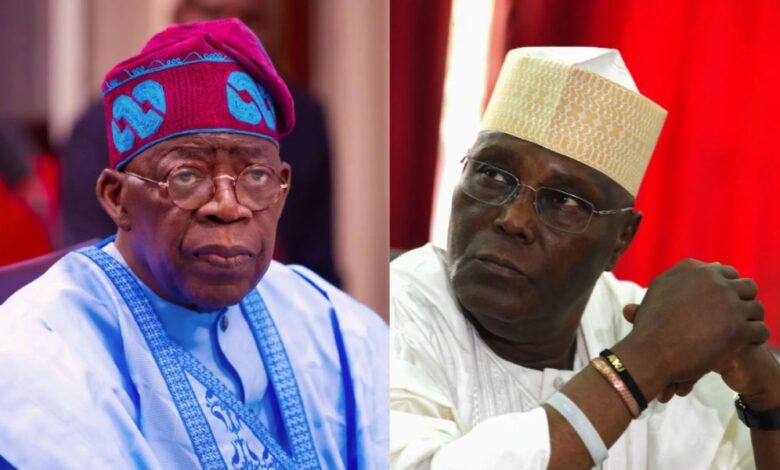
The Presidency has dismissed former Vice President Atiku Abubakar’s criticisms of President Bola Ahmed Tinubu’s economic reforms, saying the opposition leader is recycling outdated data and ignoring measurable progress made since 2024.
In a 10-point statement released on Saturday, August 2, 2026 by Bayo Onanuga, Senior Special Assistant to the President on Information and Strategy, the government accused Atiku of anchoring his arguments on the “most painful phase” of reforms while ignoring recovery indicators in 2026. Onanuga said politics thrives on disagreement, but “disagreements must be rooted in facts, not frozen snapshots of history.”
*2024 Data Cannot Define 2026 Economy*
Onanuga argued that judging the administration by 2024 figures is misleading. He noted that following the exchange-rate reset, Nigeria’s dollar-denominated GDP fell to about $253 billion, but has since recovered to approximately $377 billion — a 49% increase. Naira GDP also rose from ₦314 trillion in 2024 to around ₦530 trillion, a 69% increase. “Reforms are processes, not events,” he said, adding that the economy has evolved considerably beyond its adjustment period.
*Borrowing Defended as Productive, Not Reckless*
Responding to claims of fiscal recklessness, the Presidency said Nigeria’s debt-to-GDP ratio remains modest at barely 40%, compared to South Africa 85%, Egypt 80%, Ghana 60%, and the US 130%. More importantly, debt service-to-revenue ratio has dropped from nearly 100% in December 2022 to less than 60% today. Onanuga stressed that borrowing has been for “productive, long-term infrastructural and investment purposes” and not for recurrent consumption, and that fiscal health should be judged by economic capacity, not debt alone.
*Subsidy Removal: Savings Now Reaching States*
On fuel subsidy, Onanuga said the policy had become “a drainpipe on the economy” and accused the Obasanjo-Atiku administration of failing to act between 1999-2007. He argued that subsidy removal has led to higher statutory allocations to states and local governments, enabling increased spending on roads, schools, hospitals and salaries. Citing World Bank assessments, he said subnational capital spending has improved, describing it as “true federalism” and a bold step toward economic restructuring.
*Tax Reforms Called Progressive, Not Punitive*
The Presidency rejected Atiku’s claim that Nigerians are being taxed more. Onanuga said the reforms aim to reduce burden on low-income earners earning ₦1 million per annum and below, and small businesses with turnover under ₦100 million, while improving compliance among high-income individuals and profitable enterprises that previously evaded taxes. “The principle is that those with greater capacity should bear a larger share,” the statement read.
*Gains in Health and Education Highlighted*
The government listed social sector gains as proof of reform impact. In health, over 3,000 Primary Healthcare Centres have been revitalised, 78,000 frontline workers retrained, 100 facilities now offer free C-sections for indigent mothers, and 3 world-class cancer centres are operational in Kubwa, Enugu and Katsina. In education, Onanuga cited UBEC’s 11,000 projects and NELFUND, which has disbursed over ₦303 billion to 1.64 million students across 300 institutions, plus an end to prolonged ASUU strikes.
*Infrastructure and Investment Drive*
Onanuga said infrastructure spending across highways, rail, power, airports, housing and digital connectivity, combined with state-level projects, has helped drive the 49% dollar-GDP and 69% naira-GDP growth since 2024. He described the investments as aimed at reducing logistics costs and supporting private sector growth, with “a lot more to come.”
*”No N7.98 Trillion Oil Windfall”*
The Presidency directly debunked Atiku’s claim of an N7.98 trillion oil windfall. Onanuga explained that while Brent averaged $90 in H1 2026 against a $64.85 benchmark, production fell short at 1.6m bpd vs 1.84m bpd forecast. He added that some crude was pledged for past subsidy loans and that analysts ignore production costs, company shares and forward contracts. “Atiku will do well to show the workings for his N7.98 trillion oil windfall,” he challenged.
*Relief Programmes and Outlook*
To cushion reform pains, the government said it has launched the $3 billion NG-CARES, HOPE and SOLID programmes for health, education and vulnerable communities, plus cash transfers to 15 million households by the Humanitarian Ministry. Onanuga projected inflation to trend toward 12% by year end, after it fell to 14.4% in November 2025 before rising to 15.91% due to Middle East disruptions.
*Conclusion: Reforms Will Continue*
Onanuga concluded that while the reforms carried costs, they were necessary to correct distortions deferred by past governments. “Nigeria’s economy is not yet where it aspires to be. But neither is it where it stood at the height of its structural distortions,” he said. He urged a “mature national conversation” focused on measurable outcomes rather than slogans, insisting that President Tinubu’s focus remains on expanding opportunity and strengthening institutions.
*Credit: Statehouse Press Statement, Bayo Onanuga, August 2, 2026*