
TINUBU PREACHES BLUE ECONOMY URGES GLOBAL FINANCE REFORM, AT AFRICA FORWARD SUMMIT

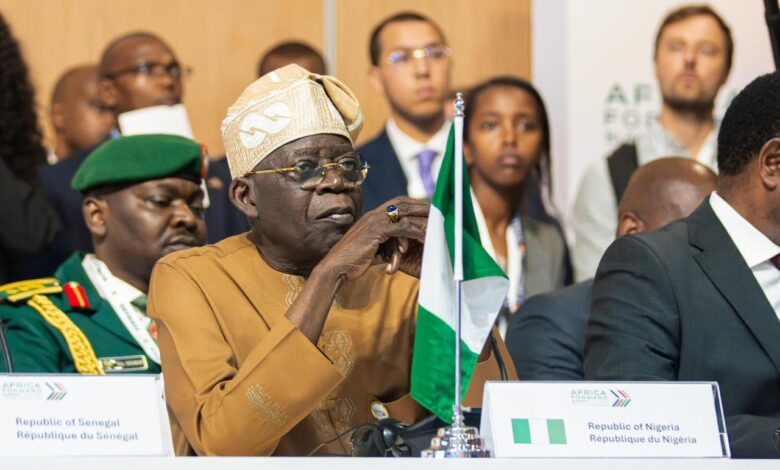
President Bola Ahmed Tinubu on Tuesday called for an overhaul of the international financial architecture, saying the current system “quietly de-industrialises” African nations and blocks industrial growth by denying affordable capital to the continent.
Bayo Onanuga Special Adviser to the President on Information and Strategy said in a statement that the President made this remarks while Speaking at the Africa Forward Summit at the Kenyatta Convention Centre in Nairobi, co-hosted by Kenyan President William Ruto and French President Emmanuel Macron,
Acording to Onanuga, the President said Nigeria had taken “painful, homegrown decisions” including fuel subsidy removal, exchange rate unification, and banking recapitalisation. Those reforms, he said, delivered a projected 32.3 per cent debt-to-GDP ratio in 2026, external reserves of $45.5 billion, and restored investor confidence. Yet Nigeria will spend about $11.6 billion on debt service in 2026, nearly half of projected revenue, he noted. “Every single dollar that leaves our treasury to pay punitive interest rates is a dollar that did not train a young Nigerian engineer or provide power for our factories,” Tinubu said.
On maritime security, the President pledged to make Nigeria’s Deep Blue Project maritime intelligence infrastructure available as a shared data hub for willing Gulf of Guinea states. He argued that “maritime sovereignty does not repel investment — it attracts it,” citing secure sea lanes, predictable regulation, and functional courts as preconditions for private capital. “Nigeria affirms that maritime sovereignty and ocean governance are the non-negotiable foundations of Africa’s Blue Economy transformation,” he said, urging interoperable systems and joint enforcement across the region.
Tinubu linked migration to economic opportunity, urging partners to ring-fence Official Development Assistance for programmes that reduce desperation driving irregular migration. He backed the African Union’s Migration Policy Framework and the Khartoum Process but called for stronger links between regional efforts and global institutions. “People who have jobs, security, and hope at home do not typically risk their lives in the back of a smuggler’s truck,” he said.
On the summit’s sidelines, the President met Madagascar’s President Michael Randrianirina and CAF President Dr Patrice Motsepe, signaling Nigeria’s readiness to host the 2026 CAF awards. The Nigerian delegation included Foreign Affairs Minister Bianca Odumegwu-Ojukwu, Finance Minister Taiwo Oyedele, Marine and Blue Economy Minister Adegboyega Oyetola, and business leaders Aliko Dangote, Abdulsamad Rabiu, Tony Elumelu, and Aigboje Aig-Imoukhuede. Ministers held bilateral talks and joined plenaries on trade, AI, agro-industry, and climate change, according to Bayo Onanuga, Special Adviser to the President, Information & Strategy.